
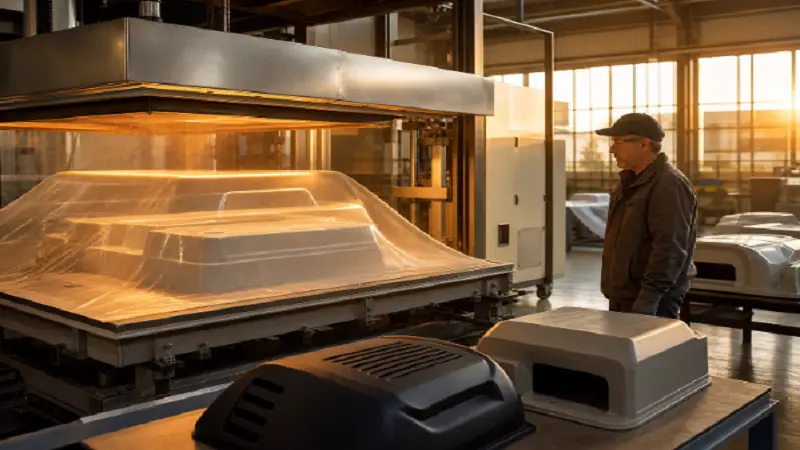
Choosing a manufacturing process is not simply a purchasing decision. It affects tooling investment, product appearance, lead time, material performance, and the ability to make design changes later. For teams developing large covers, housings, trays, panels, and equipment components, Plastic Thermoforming from Neodesha Plastics offers an engineered sheet-forming service that supports prototyping, material selection, tooling, trimming, and production. Based in Neodesha, Kansas, Neodesha Plastics serves OEM and industrial applications, including automotive, medical, material handling, marine, and equipment projects that require lightweight, durable components.
The right method depends on the entire project profile. A part that is inexpensive to produce at high volume may require costly tooling. In contrast, a flexible process with a slightly higher per-part cost may reduce risk during early development or changing demand.
Why Process Choice Shapes the Final Product
Every process has tradeoffs. It may influence tolerances, surface detail, wall-thickness consistency, secondary operations, freight costs, and assembly time. The lowest quoted unit price is not always the lowest total project cost. Before requesting quotes, teams should define dimensions, annual demand, critical features, required testing, and the likelihood that the design will change after prototype evaluation.
Start With the Part’s Job
Begin by documenting what the component must withstand in service. Consider the impact of vibration, heat, moisture, sunlight, cleaning chemicals, oils, and repeated handling. Determine whether the part protects equipment, carries a load, encloses electronics, or serves primarily as a cosmetic surface. Also identify openings, mounting points, ribs, textures, logos, and industry-specific requirements for medical, automotive, food-contact, or industrial applications. These details determine which materials and manufacturing methods are realistic.
Compare Part Size and Shape
Geometry often eliminates unsuitable processes before pricing begins. Broad panels, machine guards, liners, vehicle components, and oversized covers can be practical candidates for sheet-based forming. Deep draws require careful planning for draft, corner radii, material distribution, and wall thinning. Small components with intricate internal features may be better suited to injection molding or precision machining.
During thermoforming, a basic heated plastic sheet is formed over a mold, cooled, and trimmed. That approach can accommodate thin-gauge packaging as well as heavy-gauge industrial parts, but the final geometry must account for stretching and trim access.
Match the Process to Production Volume
- Prototype stage: Prioritize quick iterations, affordable sample tooling, and fit testing before committing to final production tools.
- Low- to medium-volume production: Compare tooling cost, setup time, finishing needs, and the value of being able to revise the design.
- High-volume production: Review cycle time, automation, repeatability, quality controls, and how tooling costs can be spread across more parts.
- Changing demand: Choose flexibility when forecasts are uncertain. A process optimized only for peak volume can create unnecessary financial exposure.
Quick Process Comparison
- Thermoforming: Strong fit for large, lightweight parts, lower tooling investment, broad surfaces, and flexible production runs. Limits can include wall-thickness variation in deep draws.
- Injection molding: Strong fit for detailed, repeatable, smaller parts and very high output. The main limits are higher tooling costs and longer tool-development commitments.
- CNC machining: Strong fit for prototypes, precision features, and solid-plastic components. It can be slower and more material-intensive for larger production quantities.
Thermoforming, Injection Molding, and CNC Machining
Thermoforming shapes a heated sheet, while injection molding forces molten plastic into a closed mold. CNC machining removes material from solid stock. None is universally better. A product team may use CNC machining for prototype fixtures or final trim operations, then thermoforming for the main shell. Hybrid production can also include drilling, routing, hardware installation, assembly, graphics, or finishing after forming.
Vacuum Forming vs. Pressure Forming
Vacuum forming draws heated plastic against a mold and is commonly appropriate for protective covers, trays, liners, and broad shapes where speed and cost control matter. Pressure forming uses compressed air to help the material capture sharper edges, textures, branding, and cosmetic details. If a customer-facing panel needs a refined surface, pressure forming may justify the added tooling and process control. If the job only requires basic shape and protection, vacuum forming may be the more practical option.
Choose Materials by Performance Needs
Material selection should follow the application. Impact-resistant plastics may be appropriate for rugged equipment covers. Clear materials can work for displays and diagnostic covers. Chemical resistance matters for cleaners, solvents, oils, and industrial fluids, while heat performance must account for both forming conditions and end-use temperatures. Color, gloss, texture, decorative films, and UV exposure also affect the decision.
Teams should also plan early for scrap, recycled content, regrind, and recovery options. Research on plastic supply chains and circularity reinforces the finding that material decisions affect both manufacturing performance and end-of-life outcomes.
Design for Manufacturability Before Tooling
- Include appropriate draft angles and practical radii rather than sharp internal corners.
- Review deep areas where stretching could reduce wall thickness.
- Plan trim lines, holes, mounting features, and assembly points before designing the tool.
- Confirm the selected material before finalizing fine details and surface requirements.
- Use prototypes to test fit, function, handling, and safety-critical requirements.
Questions to Ask Before Requesting a Quote
- What dimensions, tolerances, finish requirements, and secondary operations are essential?
- How many parts are needed for prototypes, the first year, and long-term production?
- Which material properties and compliance requirements are non-negotiable?
- Will the design likely change after initial testing?
- How will inspection, packaging, freight, scrap, and assembly affect total cost?
Conclusion
Product teams make better process decisions when they evaluate the part’s function, geometry, material demands, production volume, and full project cost together. Thermoforming, injection molding, and CNC machining each solve different problems. Early engineering review and prototype testing provide the clearest path to selecting a process that performs well in production, not just on paper. See more!